Based on your experience so far, what advice would you give to next year's Hawken Project students? What should they do to make the most of their projects?
When I started my project, I already knew a lot of the basics of blacksmithing from going to open forges when I could, but I also read a few books, watched youtube videos, and read articles online. I really think that this helped me to start ahead and I was able to do a lot more during my project. I was immediately able to start working on pieces for a project that would be sold and I learned to weld on the first day. If I had not come with prior knowledge and experience, I would have spent many days learning the basics, and not getting to work on more interesting and high-level projects.
I highly recommend that next year's students try to research, practice, or do whatever they can to start their projects ahead. This has really helped me to enjoy my project and see much more.
Tuesday, May 30, 2017

Blog #9
How have you grown from the beginning to the end of your project?
I have grown not only in my skills (blacksmithing and welding), but also in my ability to work independently. At the start of the project, I relied heavily upon other people in the shop or my mentor to tell me what to do, which part of a project to work on, where things were in the shop, etc. By the en of my project, I felt confident enough to find most everything I needed, set up the welder by myself, and work without the help of other people. This was a really gratifying feeling and it made me much more confident in my skills and abilities.
I also immensely increased my skills in both forging and welding. While my first welds were not terrible, but they are much better now.
 |
| One of my first welds (MIG) |
I have grown not only in my skills (blacksmithing and welding), but also in my ability to work independently. At the start of the project, I relied heavily upon other people in the shop or my mentor to tell me what to do, which part of a project to work on, where things were in the shop, etc. By the en of my project, I felt confident enough to find most everything I needed, set up the welder by myself, and work without the help of other people. This was a really gratifying feeling and it made me much more confident in my skills and abilities.
I also immensely increased my skills in both forging and welding. While my first welds were not terrible, but they are much better now.
 |
| One of my last welds (TIG) |
Sunday, May 28, 2017
Blog #8
Describe something fun or pleasantly unexpected that happened.


During my project, I was pleasantly surprised by how much the people in the shop took me under their wings and helped me every day. Since my mentor mostly does office work and site visits, and does not spend much time in the shop, I was on my own a lot to work. Surprisingly, whenever I needed anything or even if I was just standing there and looking around confusedly, someone would come over an help me. They would even take the time to teach me the spectrum of steel temperatures, the history of screw threads, and how to put eyes on a spider. I really appreciate the time they spent with me, at the expense of their own work, to help and teach me.

(all pictures are of work done by people in the shop)


During my project, I was pleasantly surprised by how much the people in the shop took me under their wings and helped me every day. Since my mentor mostly does office work and site visits, and does not spend much time in the shop, I was on my own a lot to work. Surprisingly, whenever I needed anything or even if I was just standing there and looking around confusedly, someone would come over an help me. They would even take the time to teach me the spectrum of steel temperatures, the history of screw threads, and how to put eyes on a spider. I really appreciate the time they spent with me, at the expense of their own work, to help and teach me.

(all pictures are of work done by people in the shop)
Wednesday, May 24, 2017
Blog #7
Describe something new that you learned.
 |
| Practicing welding |
Something that I was most excited to learn during project was welding. While I have done blacksmithing before and learned how to forge weld, this is a harder method and relatively imprecise. Being able to weld allows me to do even more projects that were not possible before.
 |
| Heron with joints welded |
I first learned MIG welding, which I have used every single day that I have been working in the shop. Most recently, I have been working on my heron, and have learned TIG welding, which I think is more difficult. You have a pedal, stick, and torch that you have to control at the same time, so it has taken longer for me to learn.
Tuesday, May 23, 2017
Blog #6
What has been a challenge for you? How did you overcome that challenge or how do you think you will overcome it?
As part of my senior project, I have the opportunity to design and create a project for myself. I struggled for quite a while to come up with an idea and figure out what to create. I think a large part of the problem was that I didn't really know what was possible. After talking to few different people at the shop, they suggested that I decide what I wanted to make and figure out the how later. I ended up deciding to make a heron sculpture.
I then had to figure out how to make it. I again got the opinions of people in the shop and decided the best way to make it would be to use a flat template and 1/4" steel. I would bend and forge the pieces to match the template, then weld them together.
 |
| Very rough sketches of my idea |
I then had to figure out how to make it. I again got the opinions of people in the shop and decided the best way to make it would be to use a flat template and 1/4" steel. I would bend and forge the pieces to match the template, then weld them together.
 |
| The heron so far... |
Sunday, May 21, 2017
Blog #5
I was most surprised by how little time Ken, my mentor, spends in the shop. I realized that he would probably not spend as much time working on projects as his employees, but I have not even seen him pick up a hammer once. This is, I think, what differentiates him form other blacksmiths. He is able to make a living blacksmithing, unlike most, but that means he is working on the business end of things, rather than doing what he actually likes: blacksmithing. The more successful he gets, the less time he spends forging.
 |
| Power hammering in the forge |
Thursday, May 18, 2017
Blog #4
How does your organization affect the lives of others? How have
you affected someone else while on project?
The Village Blacksmith is a shop, and it is for profit, but I definitely think it can still affect the lives of people. I was surprised by the effect a small railing can have on someone. The first time I helped to install a railing, it was for a woman whose daughter frequently has seizures. This railing was only for a few small steps, but it made the house so much safer for her daughter. This woman was so pleased by not only the functionality of the railing, but also its beauty and quality. In its own way, I think that by creating beautiful, functional metalwork, the shop has an effect on the lives of others.
The Village Blacksmith is a shop, and it is for profit, but I definitely think it can still affect the lives of people. I was surprised by the effect a small railing can have on someone. The first time I helped to install a railing, it was for a woman whose daughter frequently has seizures. This railing was only for a few small steps, but it made the house so much safer for her daughter. This woman was so pleased by not only the functionality of the railing, but also its beauty and quality. In its own way, I think that by creating beautiful, functional metalwork, the shop has an effect on the lives of others.
Blog #3
How were you feeling the first day of project? What were your
initial expectations? What were your hopes and fears?
My first day of project actually went pretty smoothly. I think this was mostly due to the fact that I had done blacksmithing before and not everything way completely new to me. The day mostly went as I expected, as I got to work in the shop and forge some different pieces for a project they were working on. I was surprised, however, that I was allowed to start making pieces immediately that would be sold to people. I had thought that I would be practicing and making small, unimportant things, but I was thrown right in and told to create parts for a huge project.
Coming into this project, I had hoped to learn how to weld, as this is one thing I did not know how to do. I expected that I would maybe be taught a couple weeks in or whenever someone had free time, but with an hour of entering the shop, I was already being taught to weld. The learning here is fast-paced, and I have already learned so much more than I thought I would.
My first day of project actually went pretty smoothly. I think this was mostly due to the fact that I had done blacksmithing before and not everything way completely new to me. The day mostly went as I expected, as I got to work in the shop and forge some different pieces for a project they were working on. I was surprised, however, that I was allowed to start making pieces immediately that would be sold to people. I had thought that I would be practicing and making small, unimportant things, but I was thrown right in and told to create parts for a huge project.
Coming into this project, I had hoped to learn how to weld, as this is one thing I did not know how to do. I expected that I would maybe be taught a couple weeks in or whenever someone had free time, but with an hour of entering the shop, I was already being taught to weld. The learning here is fast-paced, and I have already learned so much more than I thought I would.
Blog #2
Who are the people with whom you are currently working? Describe your colleagues and the organization for which you are working. What have you learned so far about the people at your project and the expectations of your project?
 |
| Gary forge-welding |
At the Village Blacksmith, I have been working with four different people: Ken Roby (the owner and my mentor), Gary(an employee of Ken who works in the shop), Steve (an employee and professional welder), and Shannon (another employee who paint and works on decorative parts).
Ken works mostly in the office receiving calls, working on the designs for projects, and emailing clients. This surprised me at first, because I thought he would be working in the forge like his employees, but he rarely gets to work on projects. He is usually working in the office, running errands, or visiting sites to give quotes. During my senior project, I have seen this side of running a blacksmithing business, as I have gone to visit sites with Ken, but I have also seen the actual forging and working in the shop side.
 |
| Gary and Ken installing a chandelier |
Ken works mostly in the office receiving calls, working on the designs for projects, and emailing clients. This surprised me at first, because I thought he would be working in the forge like his employees, but he rarely gets to work on projects. He is usually working in the office, running errands, or visiting sites to give quotes. During my senior project, I have seen this side of running a blacksmithing business, as I have gone to visit sites with Ken, but I have also seen the actual forging and working in the shop side.
Wednesday, May 3, 2017
Blog #1 (Pre-Project)
During my senior project, I will be working with Ken Roby, a professional blacksmith. Ken has been a blacksmith for over twenty years, and he owns the Village Blacksmith in Chagrin Falls. His work centers around hand-forged architectural ironwork, such as railings, balconies, and furniture.


Over the course of my senior project, I hope to explore what can be done within blacksmithing, especially in a professional setting. I recently started blacksmithing at a local forge, but I only make small tools and decorations. I think it will be interesting to see the types of work and other projects that a professional blacksmith does, compared to what I have been exposed to so far.
Every day at the forge will be different, and I will start out by observing and helping my mentor. We will go to installation sites, client meetings, and site visits, as well as work in the forge. I will also practice forging on my own and will eventually work on a project of my own.

(some examples of railings done by Ken Roby at the Village Blacksmith)
Every day at the forge will be different, and I will start out by observing and helping my mentor. We will go to installation sites, client meetings, and site visits, as well as work in the forge. I will also practice forging on my own and will eventually work on a project of my own.
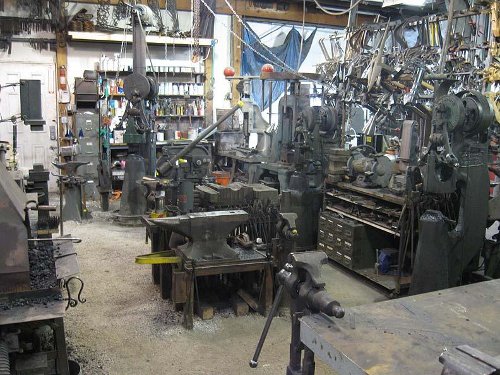
(the Village Blacksmith forge)
Subscribe to:
Posts (Atom)